POGO - I3 (1998-2002)

EU Esprit projects, I3, Experimental School Environments : POGO (1998–2001)
The idea for 'Pogo' arose from the perception that children talk and tell stories to communicate, to express themselves and to construct models of the world they are experiencing. They project their fantasy world on to inanimate objects such as toys in order to act out and engage in relationships. Early learning is thus driven by the child's need to explore his or her world by engagement with artefacts and people. These experiences are pro-actively contextualised by the child in the form of story telling with imaginary others, often facilitated by the use of inanimate objects as surrogate people within an environment. This process is further simulated and supported by the use of stories read by parents and teachers. Tipically, children's interaction with stories takes the form of an interactive experience, the story-line being embellished and changed in and through use. Pogo will therefore address story-building as the key technology focus; a means used by children to create and axplore and to develop language ans social skills.
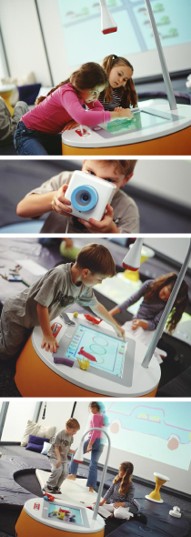
We propose that new media can provide the means for augmenting children's fantasy world. By creation of an enriched language, where text is just one part of a full spectrum of multimedia expressive elements, we will support children in exploring and developing language skills in a multi-media virtual living world called Pogo. Favourite characters or props will be moved from the virtual environment into 'real world' embodiment as intelligent active toys and devices that can 'talk', move, be squeezed and manipulated as a means of interfacing to the virtual story-world via a richer, multi-modal interaction metaphor. In this way, the final realisation of Pogo will be an augmented, living, learning environment that provides feedback to the child, the teacher and the parents.
In this project we wish to support children, teachers and parents with a collaborative virtual story world. By providing a language and environment for the expression of fantasy, role-playing, representation and presence, Pogo aims to be an instrumental in supporting the children in the development of their ability of self-expression and creativity. More over, Pogo aims to support children in their capacity of sharing stories and their collaboration process in story building. The development of narrative as a vehicle of exchange between culture is seen as equally important.
The objectives of Pogo are:
• to understand children and active learning. To understand stories, story-telling and story-building and on the basis of this understanding, to create a living, learning world in which children can build their own stories;
• to embody a new interaction paradigms in new tools. We will develop interaction paradigms in which multi-sensorial interactive devices provide children with a new means of engaging in the virtual story world of Pogo. We will create new tools which enhance learning through story telling, support story creation and allow highly sensorial interaction;
• to develop enabling technologies. We will develop a network communication infrastructure and the mechanisms to mix and synchronise 3D graphical objects with natural audio and video streams and build a functionnal prototype system through which the virtual Pogo environment and its new tools can be validated.